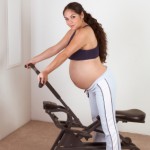

Pregnant or not, warmer weather often inspires us to get outside and get active. For most of us, that is a very good thing! Moderate strength training and aerobic exercise can be very beneficial during pregnancy as it helps strengthen the heart, lungs, bone and muscles and helps prepare the woman’s body for her upcoming labor and birth.
Healthy pregnant women can usually safely participate in moderate aerobic exercise for at least 30 minutes a day, but there are some extra considerations and precautions that pregnant women need to take prior to beginning an exercise program.
As you know, pregnancy changes things. But you may not know that there are cardiovascular and respiratory changes that occur during pregnancy.
The increasing level of progesterone during pregnancy has an effect on the respiratory center of the brain. It causes the pregnant woman to breathe more frequently than she did prior to pregnancy. As her expanding uterus and pressure from the diaphragm causes her lung capacity to decrease, her rate of respiration increases. By the end of the third trimester, her oxygen consumption has increased by 36%.
Also, the pregnant woman’s blood volume increases (40% by 34 weeks), which causes her heart to pump more frequently (an extra 10-15 beats per minute) even while resting.
Because of these and other changes, it is very important to get a thorough obstetrical medical exam prior to beginning a perinatal exercise program. Even a woman who has been involved in competitive or recreational athletics needs to have an obstetrical medical exam prior to training to identify possible risk factors. Certified perinatal fitness instructors require a medical waiver before enrolling pregnant women into their classes. It is important to know if aerobic exercise is safe for you and your baby.
There are some risk factors and contraindications that pregnant women should be aware of. Any pregnant woman involved in a strenuous exercise program should be closely medically supervised.
Here are some risk factors that may make it unsafe for you to participate in perinatal aerobic exercise:
Anemia, bronchitis, cardiac arrhythmia, Type 1 diabetes that is not controlled well, being extremely thin or extremely obese, never exercising prior to pregnancy, intrauterine growth retardation (IGR), high blood pressure, hyperthyroidism that is not controlled well, orthopedic issues, seizure disorder that is not controlled well or being a heavy smoker.
The following risk factors make it completely unsafe for you to participate in aerobic exercise:
Significant heart disease, restrictive lung disease, incompetent cervix or cervical cerclage, multiple babies at risk for premature labor, second or third trimester bleeding, placenta previa still present after 26 weeks of pregnancy, premature labor, amniotic membrane rupture or preeclampsia.
If you have any of these symptoms, you should stop exercising immediately and contact your doctor or midwife:
Chest pain, difficulty breathing, dizziness, headache, muscle weakness, vaginal bleeding or any pain, including back/pelvic area.
If your obstetrician or midwife has not found any contraindications for you to participate in perinatal aerobic exercise, you can gain a lot of benefit from 30 minutes or more of regular, moderate exercise every day of the week during pregnancy and after postpartum.
Sometimes it seems as though the birth world is split between medicated and unmedicated (“natural”) birth.
Emotions can run high on both sides and I’m not planning on getting into all that in my post today, so you can all breathe easy.
If I am working with a mom who plans to have an epidural, I always give her information and techniques she can use with an unmedicated birth anyway, just in case that’s what she ends up with, whether she plans to or not!
In the same way, I think all birthing women should have an understanding of how epidurals and spinals work, even if they are planning an unmedicated birth, just in case they have an unplanned C-section or there is some other reason they may need that type of medication.
In my article,“Explaining Epidurals,” I explain how epidurals are given, what the possible benefits or potential negative side effects might be, and explain the difference between epidurals and spinals.
I hope this information is helpful to you!
Thanks,
Julie
Hi everyone! I’ve been making some short video clips with some quick tips for labor that I hope you will find helpful. I’ve also made a few explaining some common terms used in childbirth classes, and I hope to make many more.
Pancakes? On a childbirth website? Yep! I’ve been talking to some of my preggo friends about the importance of eating high-protein foods while pregnant, and my husband suggested I post this recipe for high-protein, low-carb pancakes. Yes, these pancakes are guilt-free and SO GOOD!
February, the month of LOVE, is a great month to have a baby!

My very first baby was born in February, and it was like Valentine’s Day every day.
Starting the new year off pregnant? 
Congratulations!
Head on over to my Facebook page and let’s talk about it!
I love childbirth education. I mean, really…I’m a HUGE fan! I don’t think anything can take the place of excellent information and preparation for one of the most life-changing events ever—the birth of a baby.

Hands down, I’d say the most frequently asked question in my childbirth classes is ”How do I know when to go to the hospital?” Trying to discern that fine line between “It’s waaaay to early to get there” and “I should’ve been there SOONER!” can be unusually challenging for many preggies. Whoever is providing support for the laboring mom often find themselves staring at closely watching her, trying to sense some sort of “GO NOW” signal. But particularly for first-time moms, trying to figure out the best time to leave for the hospital can be a bit confusing.

Whoa, baby! It’s been awhile! To be honest, I got swamped this spring and haven’t had much time to update my webpage. Spring always seems to be ushered in with births and even the cows on our farm have blessed us with new little ones.